In short: Shopify is a hosted platform: you pay a monthly plan ($39 on Basic, or $29 a month billed yearly) and Shopify runs the servers, security and updates. WooCommerce is a free WordPress plugin: you pay for hosting and extensions, and you or your host look after the site. Choose Shopify to launch fast and never think about servers. Choose WooCommerce for full control, if you already run WordPress, or to use any payment provider without a platform fee on top. For a typical small store, payment fees are the biggest cost on both.
We make WooCommerce plugins and are bringing our bundle app to Shopify, so we have no reason to push either one.
The short comparison
| WooCommerce | Shopify | |
|---|---|---|
| What it is | A free plugin for WordPress, on your own hosting | A hosted platform with monthly plans |
| Platform cost | $0, plus hosting | Basic $39 a month ($29 billed yearly), Grow $105 ($79), Advanced $399 ($299) |
| Payment fees | Your provider’s; WooPayments is 2.9% + 30¢ for US cards | Shopify Payments’ rates; another provider adds 2% on Basic, 1% on Grow, 0.6% on Advanced |
| Hosting, security, updates | You, or a managed host | Shopify |
| Design and code | Any WordPress theme, full access to the code | Shopify themes; the checkout itself is deeply customizable only on Plus |
| Extensions | WordPress plugins | The Shopify App Store |
| Content and blogging | WordPress, the strongest there is | A simpler built-in blog |
| Your data | Your own database | Shopify’s, and you can export it |
Shopify prices are the US prices on its pricing page in October 2026; they differ by country.
What a store really pays each month
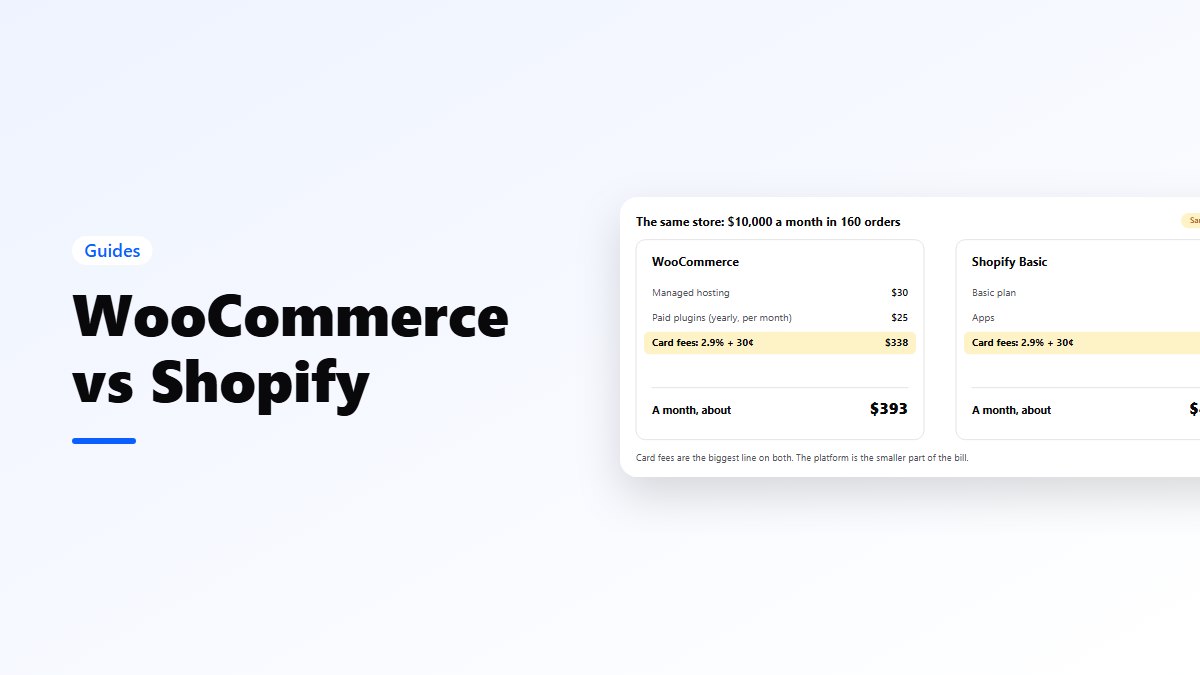
The platform fee gets the attention, but it is rarely the biggest number. Here is a sample US store selling $10,000 a month in 160 orders:
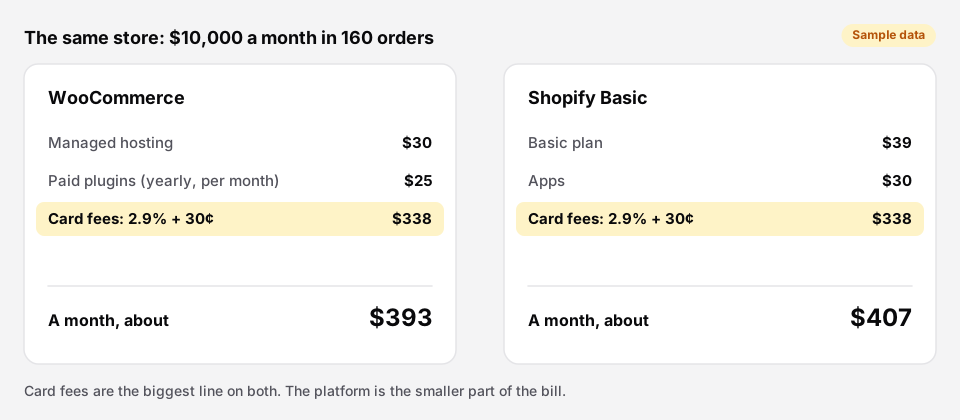 Sample numbers. Your hosting, apps and payment mix change them.
On both platforms, card fees come to about $340 a month. Hosting and paid plugins on one side, the plan and apps on the other, add $50 to $100. The totals end up close. What decides is the rest: your time, what you need to customize, and which payment providers you can use.
That last point matters outside the US. Where Shopify Payments isn’t available, every order goes through another provider, so the extra 2% on Basic applies to all your sales. Check Shopify’s pricing page for your country before you compare.
When Shopify is the better choice
- You want to sell this week, with no developer and no hosting account.
- You don’t want to own maintenance: no plugin updates, backups or security patches to think about.
- You expect big traffic spikes from ads or a viral post. Shopify scales without you calling a host.
- You sell in person too. Shopify’s point of sale ties in-store and online stock together.
When WooCommerce is the better choice
- You already run WordPress, or content is how you get customers. WordPress is the best blogging and SEO tool there is.
- You need unusual product logic: custom pricing, B2B rules, product configurators. You can change any line of code.
- You want your own payment provider without a platform fee on top.
- You want to own everything: the code, the database, the hosting. Nobody can change your plan or your terms.
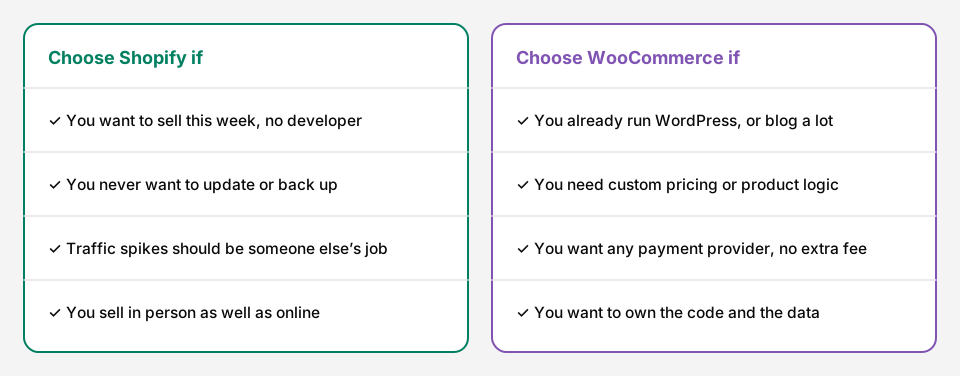 Neither list is better. It depends on which column sounds like you.
Which is better for SEO?
Both can rank on page one, and neither does the work for you. WordPress gives you more control over URLs, page structure and content. Shopify fixes some paths, such as /products/ and /collections/, but its hosting is fast everywhere out of the box. A WooCommerce store’s speed depends on its host and plugins.
What ranks is the same on both: pages that answer what people search for, product pages with real detail, and other sites linking to you.
How many stores use each?
W3Techs, which tracks the technology behind websites, counts WooCommerce on 47.4% of the sites using an ecommerce system it tracks and Shopify on 32.3% (October 2026). WooCommerce is still ahead, but Shopify’s share has been growing year on year.
Can you switch later?
Yes, in both directions. Products, customers and orders can be exported as CSV files or moved with migration tools. Two things need care: your URLs change, so set up redirects from every old page, and your apps or plugins have to be replaced with their equivalents.
Bundles on either platform
Whichever you choose, product bundles are one of the easiest ways to raise order value.
- WooCommerce: Nanflows Bundles is free on WordPress.org for fixed bundles and frequently bought together. Pro adds eight more bundle types from $39 a year on the Nanflows Bundles page.
- Shopify: Nanflows Bundles for Shopify is coming to the Shopify App Store, with every feature on every plan.
- Compare plugins: the best WooCommerce bundle plugins.
FAQ
Is WooCommerce cheaper than Shopify?
The plugin is free and Shopify Basic is $39 a month, but hosting, plugins and payment fees narrow the gap. For a small store selling $10,000 a month, both usually land at a similar total, because card fees are the largest cost on each.
Is Shopify better than WooCommerce for beginners?
Usually, yes. Shopify handles hosting, security and updates, so a beginner can open a store in a day. WooCommerce is approachable with a managed WordPress host, but you are responsible for updates and backups.
Which is better for SEO, WooCommerce or Shopify?
Both can rank well. WordPress gives more control over URLs and content, while Shopify’s hosting is fast by default. Content, product detail and links from other sites matter far more than the platform.
Does Shopify charge transaction fees?
Not on orders through Shopify Payments. If you use another payment provider, Shopify adds 2% on Basic, 1% on Grow and 0.6% on Advanced, on top of the provider’s own fee.
Can I move from WooCommerce to Shopify, or back?
Yes. Products, customers and orders can be exported and imported, or moved with a migration tool. Set up redirects from your old URLs, and replace each plugin or app with its equivalent.